Faversham Life
Words Justin Croft Photographs Natural History Museum and Royal Botanic Garden, Kew
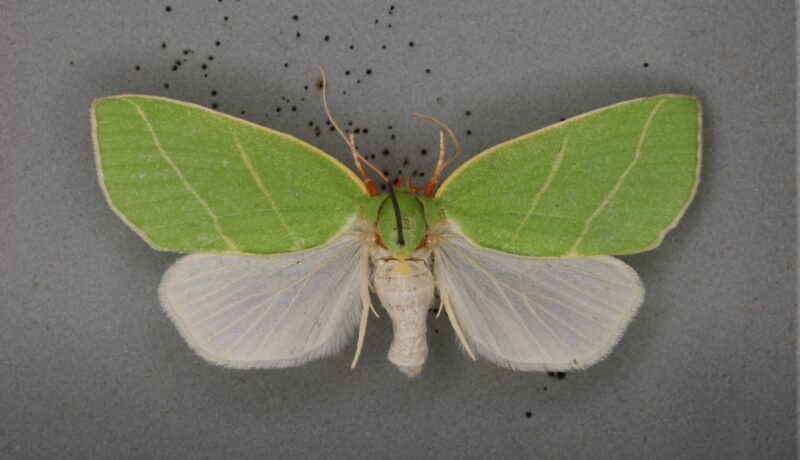
Bena bicolorana. Scarce silver-lines moth. Collected in Faversham in 1925
During the autumn months, many of us have noted the profusion of quick-flying moths, especially the exotic and improbable-looking hummingbird hawkmoths bumping over garden fences to bury their elegant, coiled proboscises into late-flowering blooms. Tiger moths, spreading their mosaic wings in the sunshine, have quickened our pulses, somehow bringing a savour of more exotic climes to our parks and gardens. But with colder nights and frost in the air, they’ve hidden themselves, and we’ve moved inside.
This week we’ve been peering into the Natural History Museum and the Royal Botanic Gardens, Kew via their mind-boggling digitised collections, visible to anyone with an internet connection, anywhere in the world. Like most museums, the Natural History Museum shows only a tiny percentage of its specimens and, for every green and succulent plant growing at Kew, there are thousands of pressed and preserved specimens in its Herbarium. Until quite recently, these breathtaking collections have been largely obscure, except to the most expert and determined researchers. Digitisation has thrown open the doors to these natural treasuries and we encourage you to join us in exploring them.
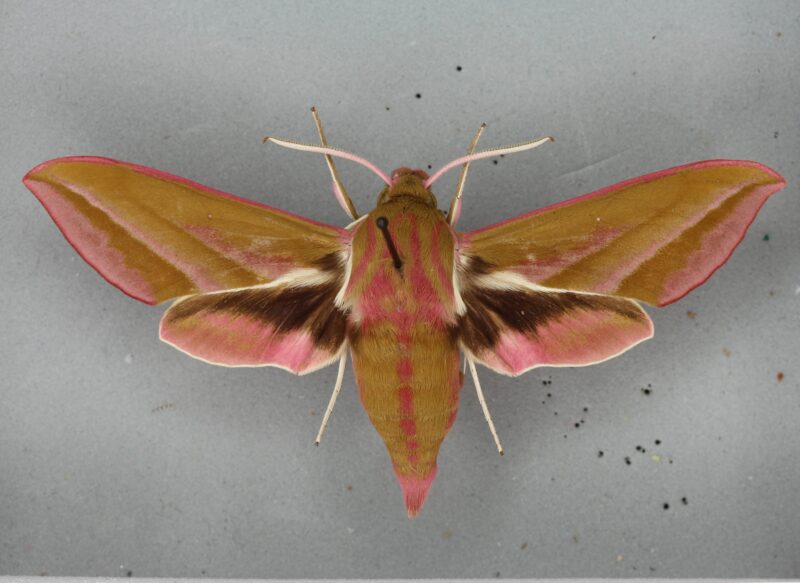
Deilephila elpenor. Elephant hawk moth. Collected in Faversham in 1926
Looking for hawkmoths, the most luxuriant of British moths, is always rewarding. One of the Natural History Museum’s examples is a 100 year old elephant hawkmoth from Faversham, plump and pink but caught, killed and pinned to a card by an enthusiast in June 1926. The collector’s name was Henry Charles Huggins (‘Harry’), a Gravesend-born bank manager with a taste for Kent wildlife, who must have made weekend outings to Faversham with his net and killing jars to put together an unrivalled collection later donated to the museum.
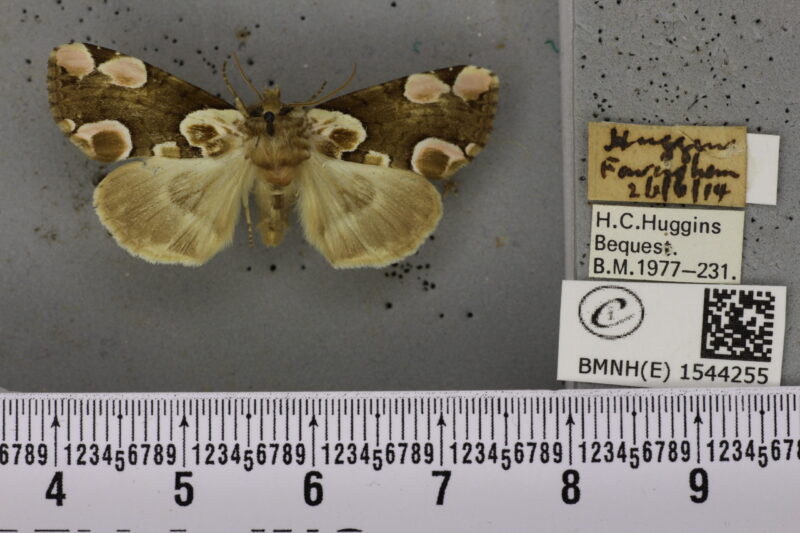
Thyatira batis. Peach blossom moth. 1914. Pinned, labelled, curated
There’s no getting away from the brutal details of lepidoptery in the past. Specimens died by chloroform at the hands of their collectors, to be skewered into cabinets, neatly labelled with the place and date of their demise. Harry Huggins was typical of many collectors of his generation but distinguished himself as a regular contributor to learned journals over many years. While we might now be horrified by his methods, his articles and collecting were serious scientific endeavours.
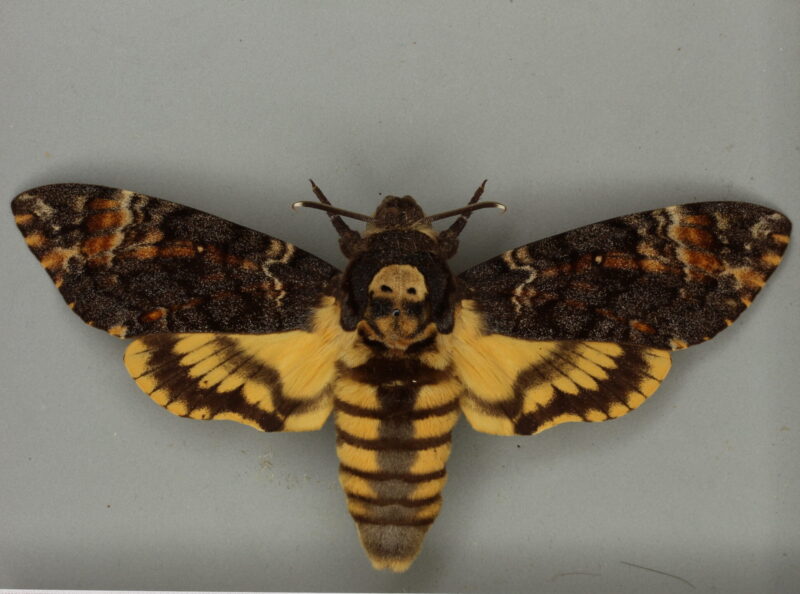
Acherontia atropos. Death’s-head hawkmoth
Lepidoptery (the study of butterflies and moths) as a pastime had its origins among the so-called ‘Aurelians’ of the 18th and 19th centuries — leisured insect enthusiasts who not only caught butterflies and moths but also bred them at home. Faversham had its own Aurelians, notably the Giraud family, which included the Victorian flower painter Jane Elizabeth Giraud. She seems to have been an expert in the breeding of moths and other insects, including that most sinister looking of British moths, the death’s head hawkmoth. But her interest may have been less in the moth itself than in an extraordinary example of parasitic cuckooing, namely the Ichneumon Atropos wasp, which lays its eggs inside hawkmoth caterpillars – consuming the host from the inside before emerging from the pupa.
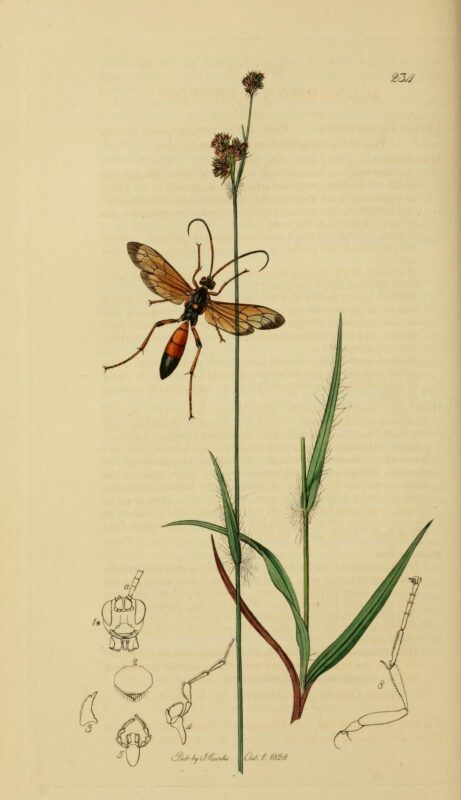
Ichneumon Atropos. Hawkmoth-botherer wasp. From The British Entomologist
Jane Giraud supplied an example of one of these wasps, bred in a death’s head hawkmoth larva, to the eminent naturalist John Curtis, who credited her in a footnote to his seminal work The British Entomologist. It’s often said that Victorian Aurelians like Jane Giraud pursued entomology as an example of the infinite providence of God’s creation, but what she made of the so-called ‘hawkmoth-botherer’ wasp she bred is not recorded.
The Natural History Museum Data Portal contains several hundred specimens with Faversham origins worth exploring. The portal allows searches by place name, so it’s fun to type these in and see what emerges. For Faversham, most are insect records, but there are also plants. For botanical enthusiasts, we can head over to Kew Data Portal for more delights.
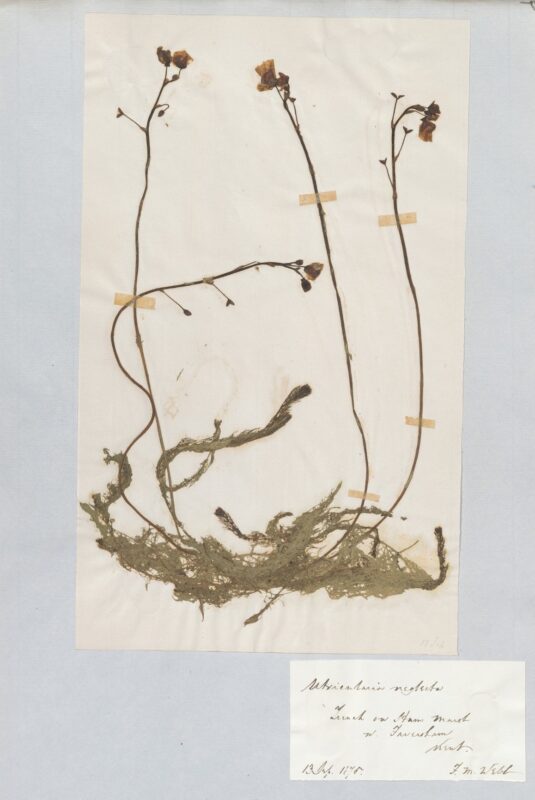
Utricularia. Bladderwort
This aquatic bladderwort collected in Ham Marshes in 1875 is surely one of the most ingenious British plants. It’s now very rare in Kent, its habitats relentlessly threatened by agrochemicals and development, and it has not (as far as we are aware) been recorded in Faversham in recent years. It is insectivorous, deriving nourishment from tiny underwater pods or bladders which devour microscopic prey in a most astounding way. A swimming bug brushes a minute hair on the outside of the bladder, triggering a convulsion which opens a trapdoor, sucking the hapless creature inside, where it is promptly digested. An unsung hero of the carnivorous plant world, bladderwort’s insectivorous capabilities are just as devious if more covert than the attention-grabbing venus fly trap.
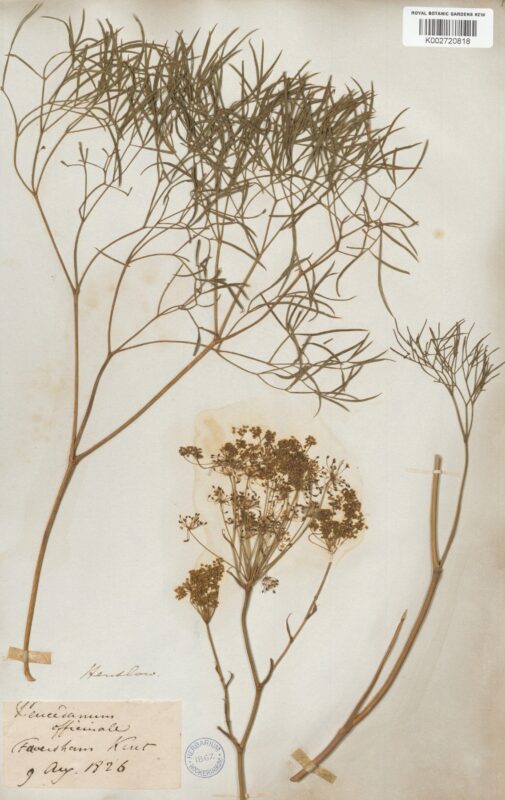
Peucedanum officinale. Hog’s Fennel
We were also excited to find several specimens of hog’s fennel, including this one harvested in Faversham almost exactly 200 years ago. This is another rarity, with Faversham Creek being one its most enduring habitats. The antiquary Edward Jacob mentioned it growing near Thorn Creek (exactly where it still grows today) in 1777 in his rare and wonderful book, Plantae Favershamienses: A Catalogue of the More Perfect Plants Growing Spontaneously about Faversham. Over a century before, the herbalist Nicholas Culpeper also wrote that hog’s fennel ‘groweth plentifully in the Salt low Marshes neer by Feaversham in Kent’. It is to be fervently hoped that it will continue to be allowed to grow here both spontaneously and plentifully.
The Kew specimen is doubly interesting for having been collected by John Stevens Henslow, professor of botany at the University of Cambridge, perhaps most famous as the teacher of a young Charles Darwin. Rochester born, Henslow was one of the most eminent botanists of his age and maintained strong Kent connections. He collected plant specimens voraciously with a view to collating and comparing them to identify differences of species and subtle variations within them. It was precisely this method that paved the way for Darwin’s world changing theory of evolution.
The humble hog’s fennel in the Kew herbarium collection shows us exactly why all these carefully kept specimens are important. Not only did they enlighten their collectors and allow them to make scientific deductions of immense consequence, but they endure in physical form so that they can be looked at again and again in the light of newer discoveries. The science of DNA has made them all the more valuable, because scientists can sample original materials in unlocking the secrets of life on earth. The more specimens are catalogued, digitised and analysed, the more we understand the changing distribution of species and, it must be said clearly, their catastrophic decline in the last few decades. A glance at recent data compiled by fantastic organisations such as Kent Wildlife compared to the riches of records from the past makes that viscerally clear.
Text: Justin Croft. Photography: Natural History Museum and Royal Botanic Garden, Kew