Faversham Life
Faversham Life
Words Amicia de Moubray Photographs Harris (Belmont) Charity
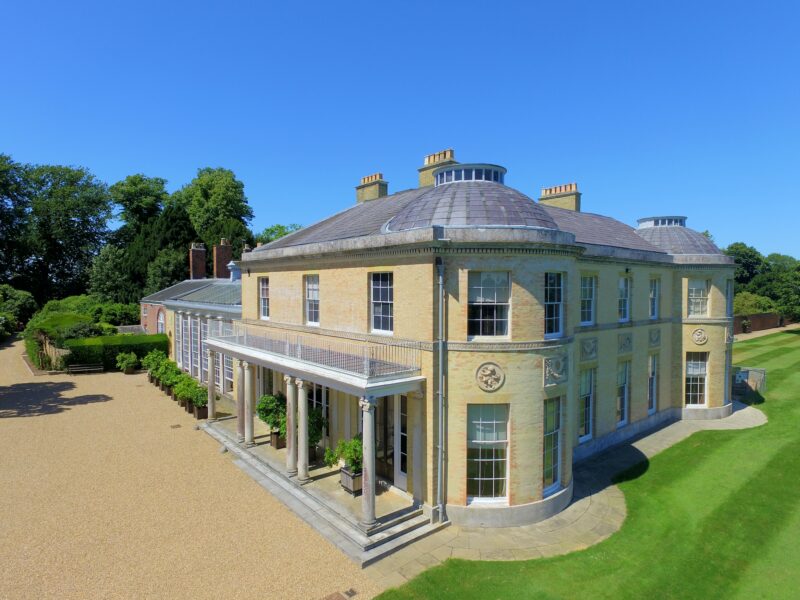
The supremely elegant late 18th century Belmont House, designed by Samuel Wyatt, of the famous Wyatt dynasty of architects, a few miles from Faversham, deserves to be much better known.
Belmont, near Faversham
Located in a ravishingly beautiful parkland setting, the neo-classical house is a microcosm of the history of a family entwined for five generations with the British army and Imperialism.
The first house on the site was built by Edward Wilks, the store-keeper of the Royal Powder Mills in Faversham in 1769. It was an unassuming red brick house five bays wide. Just 11 years later, he sold the house to Colonel John Montresor, an intriguing character: a cartographer, and a British army officer who fought in the War of Independence and was chief engineer and barrack master for North America. On his return to England, he bought Belmont commissioning a much larger mansion from Samuel Wyatt to replace Wilks’s house, as well as enlarging the park and the estate. Some of the original house was incorporated into the service wing.
But alas, poor Montresor, having had such a riveting life, met a surprisingly tragic end, dying in Maidstone gaol in 1799 having been wrongly accused of embezzling army funds. His valiant sons managed to overturn the indictment, and were awarded a staggering £450,000 from the Treasury as compensation.
On Montresor’s death, the estate was sequestrated by the government and sold by auction at a London coffee house in 1801 to General George Harris. Thus began the house’s long association with India. Harris had become rich from a glittering military career in the subcontinent. As Commander in Chief of the Madras Presidency, he led the campaign against Tipu Sultan who was supporting the French against the British. He received well over £100,000 in prize money for taking the Fort of Seringapatam, thus establishing British rule over southern India. In 1815, his derring-do was recognized when he was made Baron Harris of Seringaptam, Mysore and of Belmont. There is a splendid life size statue commemorating him in Throwley church (see Faversham Life article).
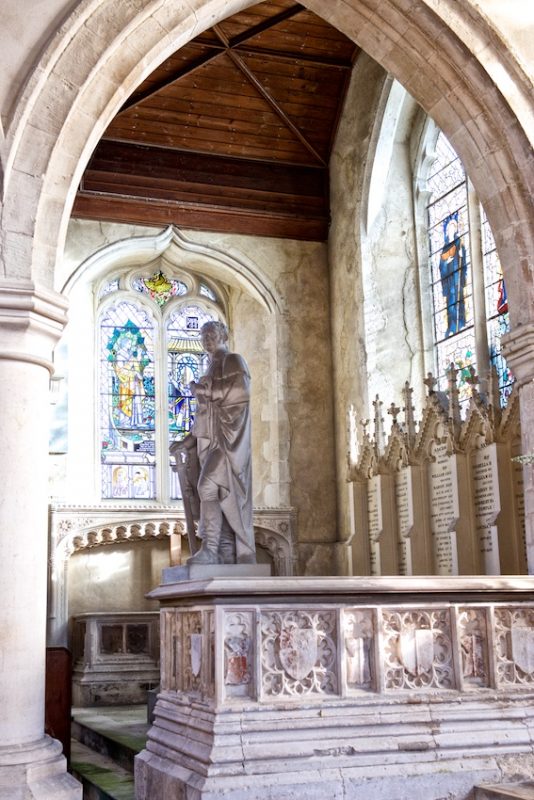
The 1st Lord Harris in the North Chapel
The eagle-eyed will spot artefacts and weapons all over the house accrued by several generations of the Harris family. There is a particularly fine collection of armour and weapons, some of which originally belonged to the Mysore armouries.
Successive Lord Harrises spent time in India – astonishingly the 2nd Lord at the tender age of sixteen was with his father at the Siege of Seringapatam. The 3rd Lord was Governor of Madras and the 4th was undersecretary of state for India (under Lord Randolph Churchill), subsequently becoming Governor of Bombay from 1890-1895. Also known as the ‘Cricketing Lord Harris’, he played a large part in inspiring Indians to take up cricket and participating in Test matches. He believed that the game was a civilizing agent and the disciplines learnt from obeying the laws of cricket would help all young people in future life. He captained the Kent team for 16 years.
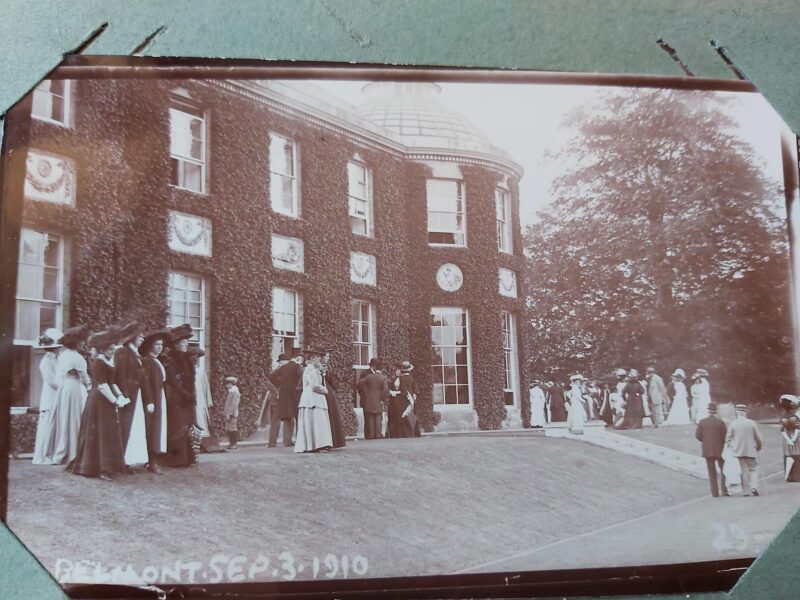
Belmont c.1910 shows the house covered in ivy
The 3rd Lord Harris, one-time Governor of Trinidad, was responsible for the extensive collection of watercolour and oil paintings by the Trinidadian Michel-Jean Cazabon (1813-1888), depicting life in Trinidad in the 1850s, that hang in the house. The son of Creole French landowners, he was educated in France and England and exhibited at the Louvre every year from 1842-1847, before returning home.
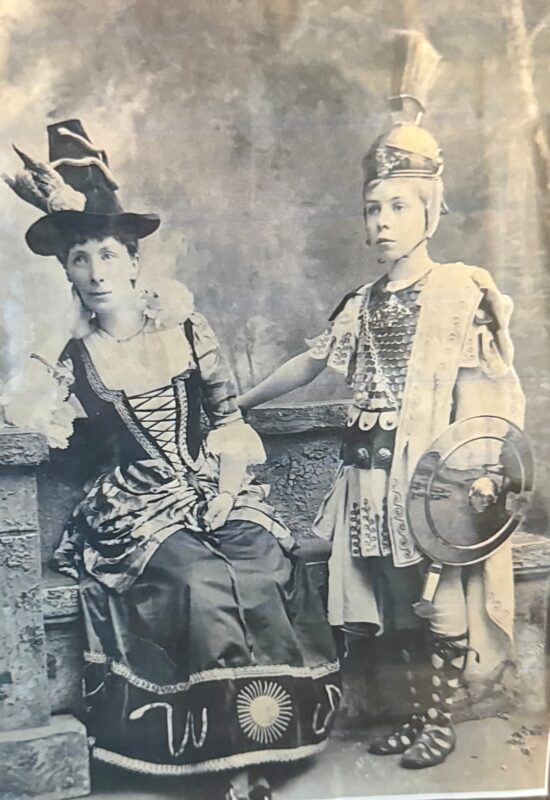
Visiting Belmont today is to step into a country house preserved in aspic from the 1970s. In some ways it is reminiscent of several surviving Anglo-Irish houses in that nothing remotely modern seems to have ever penetrated the interior. However, a few rooms have been ‘dressed’ as Andrea Davies the estate manager says, using items found in the attics such as the clothes of Dorothy, the wife of the 5th Lord Harris along with old invitations and photographs. ‘The attics are full of items.’
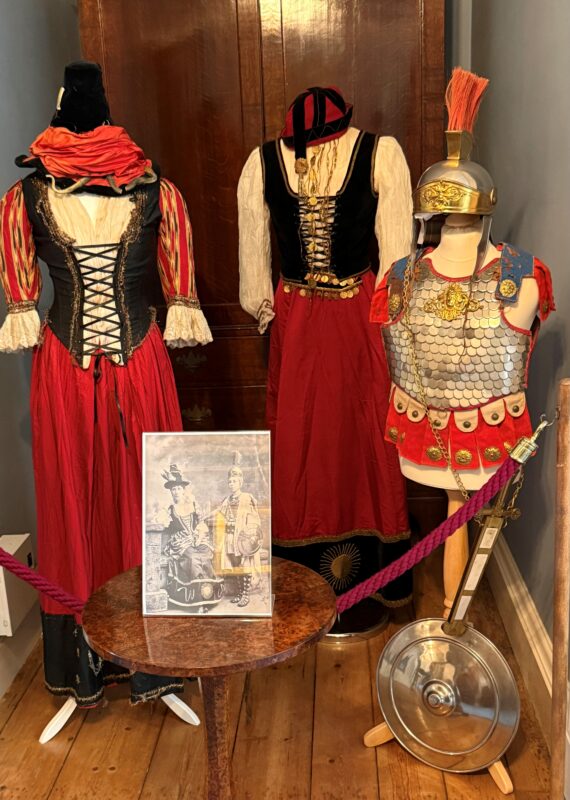
Children’s fancy dress costumes found in the attics
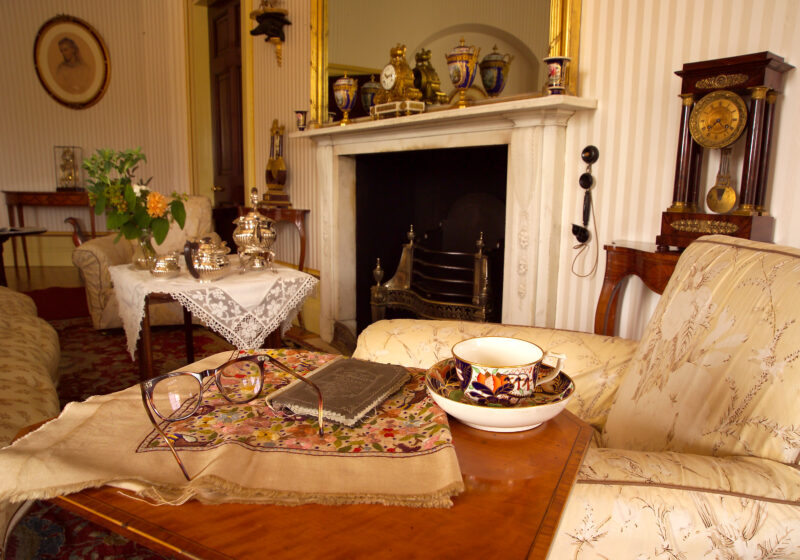
A ‘dressed vignette’ in the drawing room
In 1980, the 5th Lord Harris established the Harris (Belmont) Charity and the clock stopped. It is apt that this Lord Harris garnered an outstanding collection of more than 300 English and French clocks from the 17th, 18th and 19th centuries that attract many horological enthusiasts.
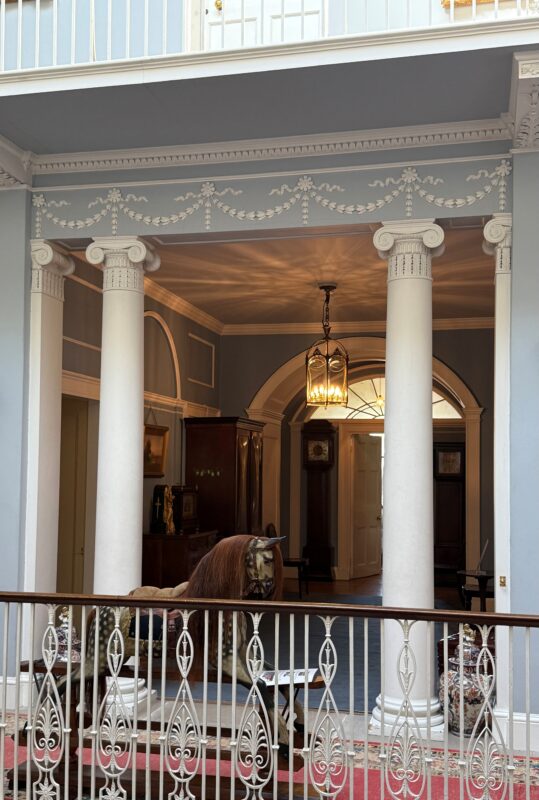
The saloon
On stepping into the house, one is immediately struck by the lightness and graciousness of the proportions. The ground floor corridor spans the length of the house so that one is drawn through the ground floor towards the full length window at the far end. The Saloon, aka the staircase hall, is an extremely handsome space rising through the full height of the house. It is hung with an extensive collection of family portraits.
The 4th Lady Harris was a talented amateur artist – examples of her work can be seen in the house. She must have been something of an eccentric as, during the First World War, she kept chickens in the attics to contribute to the ‘war effort’. The late Jack Oldfield of nearby Doddington Place used to recount that, whilst staying at Belmont, he was somewhat surprised to hear a great clucking noise in a cupboard in his bedroom only to discover that it was a hen laying an egg.
The principal rooms, the drawing room, the library (still intact with its original Wyatt shelves) and the dining room all have outstanding views out over the parkland.
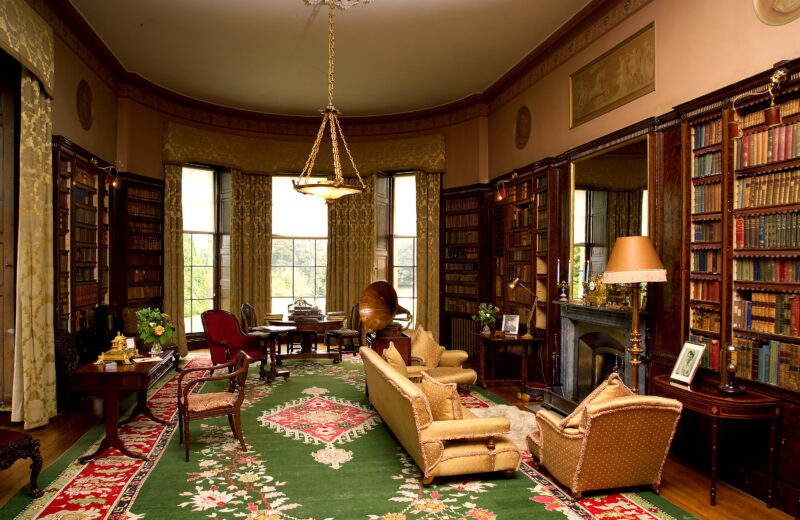
The library with shelves designed by Samuel Wyatt
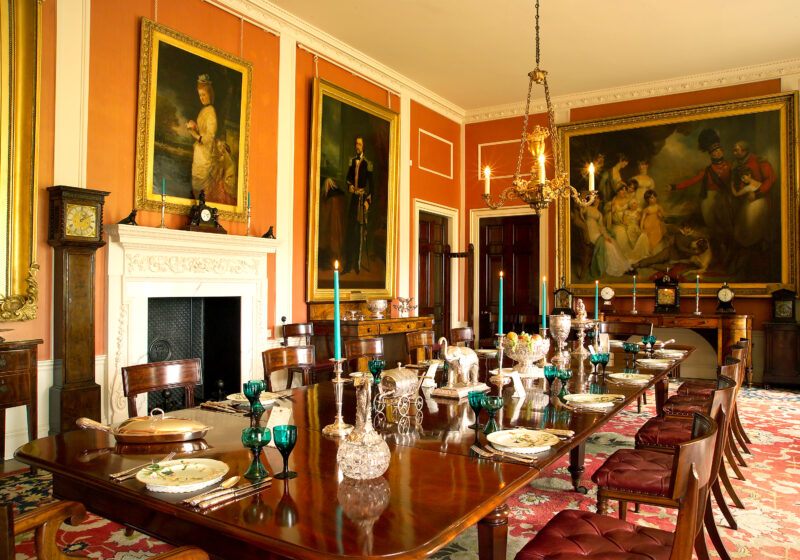
The dining room
For connoisseurs of interior decoration, the drawing room decorated by Basil Ionides in the 1920s will be of great interest. Author of two influential books ‘Colour and Interior Decoration (1926) and Colour in Everyday Rooms (1934), he helped Duff and Lady Diana Cooper do up their Gower Street house, and decorated the Savoy Theatre. He is described as ‘the most interesting colour theorist of his generation’ by Stephen Calloway in his magisterial tome Twentieth-Century Decoration.
I looked carefully at the curtains, having read his dikat in a Country Life article: ‘A badly hung chintz curtain is one of the most depressing things possible. When well made it is, with its crispness, most refreshing’.
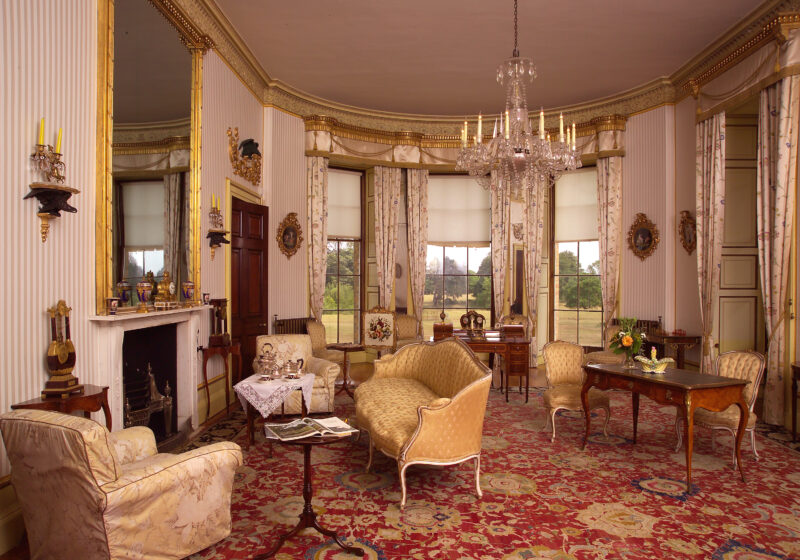
The drawing room decorated by Basil Ionides, the influential decorator of the 1920s and 1930s
Belmont is decidedly unKentish in appearance. At first glance one might think it was in Norfolk. This can be explained by the fact that Samuel Wyatt worked at Holkham Hall in Norfolk between 1784-1807 during the period when he designed Belmont (1789-1793). The pale yellow mathematical tiles cladding the exterior are believed to have come by boat from the Peterstone brickworks on the Earl of Leicester’s Holkham estate. The roof is covered in large slabs of Penrhyn slate from quarries in North Wales owned by Richard Pennant, another of Wyatt’s clients, whose estate was managed by Samuel Wyatt’s younger brother, Benjamin.
The Coade stone plaques on the exterior are a distinctive feature. A highly durable weather resistant artificial stone invented by Eleanor Coade in 1769 to her own secret recipe. It is remarkable material and can be seen everywhere from keystones in Bedford Square to Lord Nelson’s pediment on the Old Naval College in Greenwich.
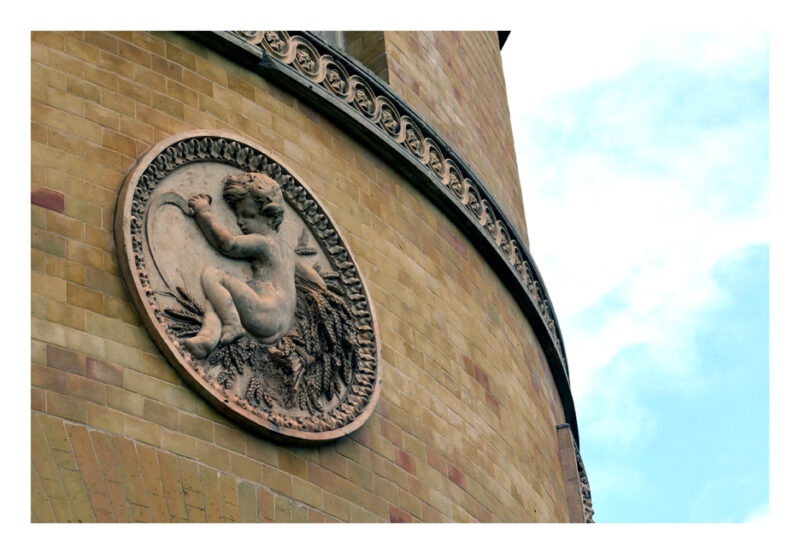
One of the Coade stone plaques that decorate the exterior of Belmont
The house is open on Thursday, Friday and Sunday April to September
Guided tours 11am on Thursdays and Fridays and at 11am and 1.30pm on Sundays
Self-guided tours on Thursdays and Friday afternoons (1pm-3pm, last entry 3pm)
Pre-booked specialist clock tours are available.
A programme of workshops from May through to December.
Text: Amicia de Moubray. Photographs: Harris (Belmont) Charity