Faversham Life
Faversham Life
Words Posy Gentles Photographs Carmelite Charitable Trust and others
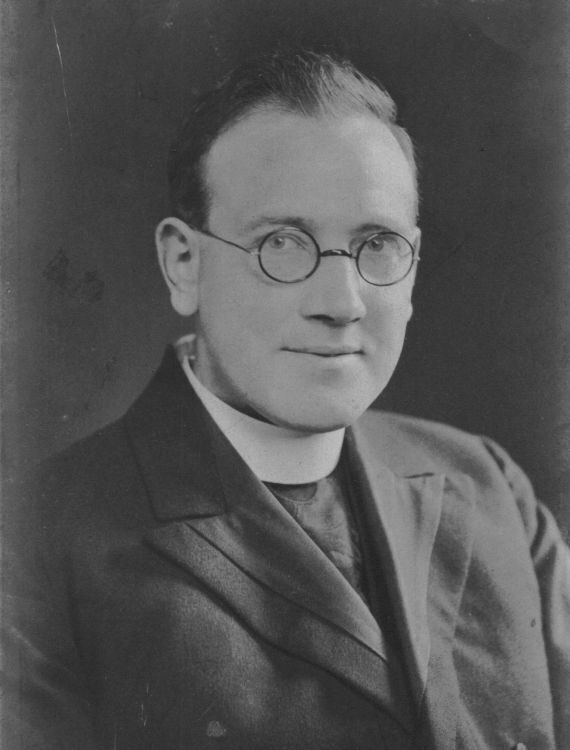
When the Carmelite Order returned to Britain in 1926 after almost 400 years’ absence, it established a foothold, albeit a rocky one, in Faversham. This year is the centenary of their coming and Faversham Life mined the excellent and amusing biography of Fr Elias Lynch, Friar Beyond the Pale, written by Wilfred McGreal O’Carm, to discover the story of how the British Province of the Carmelites rooted itself in this small historic market town with little significant Catholic presence, and spread its influence far beyond. It is also a story of Faversham.
The Carmelite Order, also known as the White Friars because of the white mantle they wear over their brown habits, first arrived in Britain in 1242, settling at Aylesford, from whence it fled some 300 years later when the Act of Supremacy was passed in 1534, its property seized by the Crown, and its monasteries broken apart.
Then for four centuries, there was nothing until, in 1926, the Catholic Archdiocese of Southwark gave the Carmelite Order two rural parishes in Kent – Sittingbourne and Faversham.
Looking back, it didn’t really seem the most promising position for reintroducing the British Carmelite Province, which had been the largest in the Order until its dissolution in the Reformation. In its favour, Faversham was 20 miles east of Aylesford (the centre of the pre-Reformation Carmelites, but in the mid 1920s, a private house), and there was the robust and persuasive character of Fr Elias Lynch, ‘The Big Man’.
Three brothers, all Carmelite priests from a farming family in County Wicklow, are integral to this story: Malachy, Kilian and most significantly, Elias. Fr Malachy Lynch from County Wicklow arrived first – there is a photograph of him celebrating mass in the ruins of Faversham Abbey in 1929, the centenary of Catholic Emancipation. After he was recalled to Ireland, his brother Elias arrived in Sittingbourne in 1931.
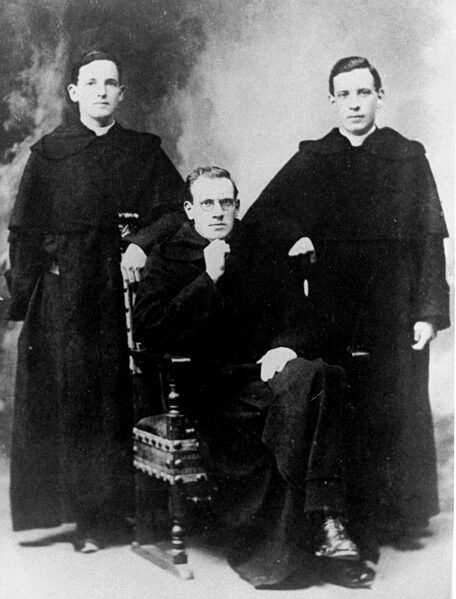
The Lynch brothers from County Wicklow (l-r) Malachy, Elias, Kilian
Despite the very best of intentions, his first years can only be described as calamitous.
It is the way of Carmelite priests to live as members of the community, not as isolated individuals. The Sittingbourne Catholic community was scattered so, with his large optimistic embrace, Elias decided to open a social club with a bar to bring the community together, and maybe raise funds for the parish. The bar side of it was very successful and the News of the World somehow picked up the story and turned it into a scandal, portraying the well-meaning Elias as the landlord of the ‘Whitefriars Arms’.
The Archbishop of Southwark and the Carmelite Elders in Ireland were unimpressed and steely. It looked as though all might be up for Elias; he had lasted in Sittingbourne only 18 months. Then they decided to send him to Faversham.
Elias certainly felt he had been hustled out, writing: ‘I was sent into exile in Faversham where I couldn’t possibly do any more harm. They were right! It took me two years to recover my equilibrium.’
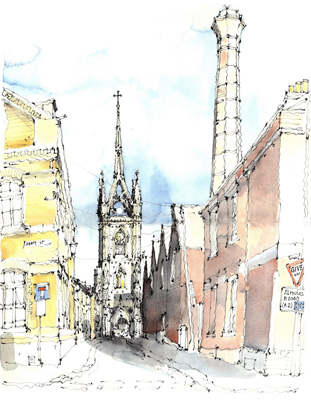
It was an unhappy and lonely start and felt to Elias like a punishment. He wrote how, on arrival, his spirits had momentarily lifted when he walked down Stone St and spotted the towers of the chapel of the Almshouses, and mistook them for a Catholic church. Disabused by the sign outside, he appealed to a passerby who directed him to Plantation Rd. Here, he found the church – ‘a little place like a minor garage’, ‘the dingiest little box you ever saw’ as he variously described it. He remembered: ‘The people came to Mass but they didn’t seem pleased to see me. They didn’t want to talk to me.’ Shopkeepers wouldn’t give him credit; only cash on delivery. Elias found himself searching in the mirror for any criminal tendencies in his face: ‘In the end, I decided my nose was too big.’
There was little money in the Faversham parish, and rural East Kent at this time was not particularly hospitable to Catholics, who were mostly foreign. Elias determined he would stay in Faversham only six months and no longer. ‘I said to myself: “I wish they had sent me to Africa”.’
The Carmelites are a mendicant order and Elias became a beggar, working in order to live and relying on the providence of God. Despite this dispiriting introduction to Faversham, Elias was still only in his 30s and irrepressibly full of ideas. His resilience carried him, yet he felt that the parishioners found his vigour disconcerting and were unused to his direct and forthright way of dealing with things. Elias was convinced they thought he was mad.
That aside, Elias realised that he needed to expand his reach if he was to finance his ministry. He started a newsletter promoting devotion to St Therese of Lisieux, the infant Jesus and St Jude the Apostle. By 1935, Elias had raised enough funds to negotiate with local estate agents Stidolph’s, the purchase of a property in Tanners St, comprising the Bible School (built in 1861 and the home of the Empire Picture Hall since 1910), the adjacent house – a fine Georgian building dating from 1743 which had been the home of John Gilbert a tanner, and a large garden running along the banks of Westbrook Stream. He got it for £900.
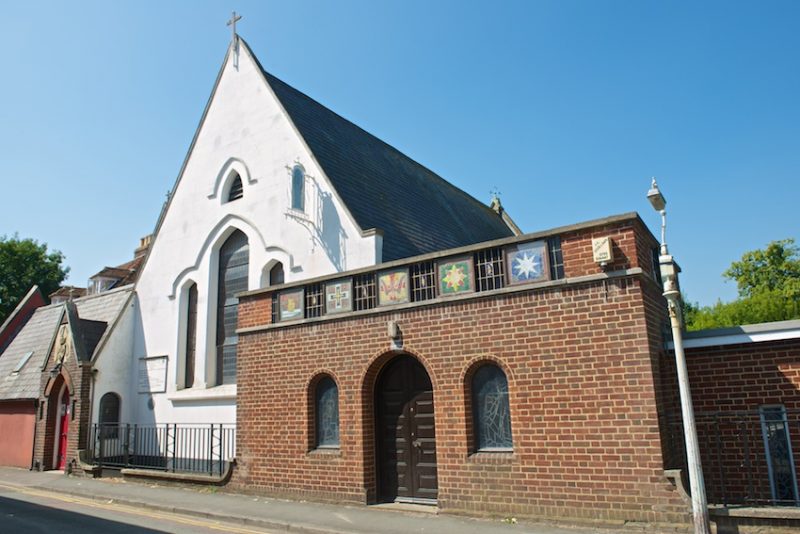
Our Lady of Mount Carmel
By 1937 the Carmelites were established in Tanners St, the church named Our Lady of Mount Carmel and the presbytery, Whitefriars. In 1938, Elias set up the Carmelite Press so that he could produce the newsletter and other literature. Devotion to St Jude, who offered hope in the face of despair grew during the war, and the demand for prayer cards rocketed.
Thus established, Elias became a recognisable figure in Faversham and served on the town council for 14 years. He stood as an independent with the hilarious slogan: ‘Don’t flinch – vote for Lynch!’. He became chairman of the housing, town planning and industrial development committees, and was involved at county level advising on planning and education. One of his main achievements was ensuring the building of council houses in Faversham after the war.
Elias became part of Faversham life and made good friends who supported him in his mission. Among these were the Russian Orthodox Princess Andrew Romanoff, wife of the nephew of Tsar Nicholas II, who lived at Provender just outside Faversham; Jack Oldfield of Doddington Place; the Irish lesbian novelist Kate O’Brien who lived in Boughton; Harry Knowles, a greengrocer awarded honorary freedom of Faversham, and mayor 1948-1950; and the Ardizzone family of whom the renowned artist Edward painted the murals in the sanctuary.
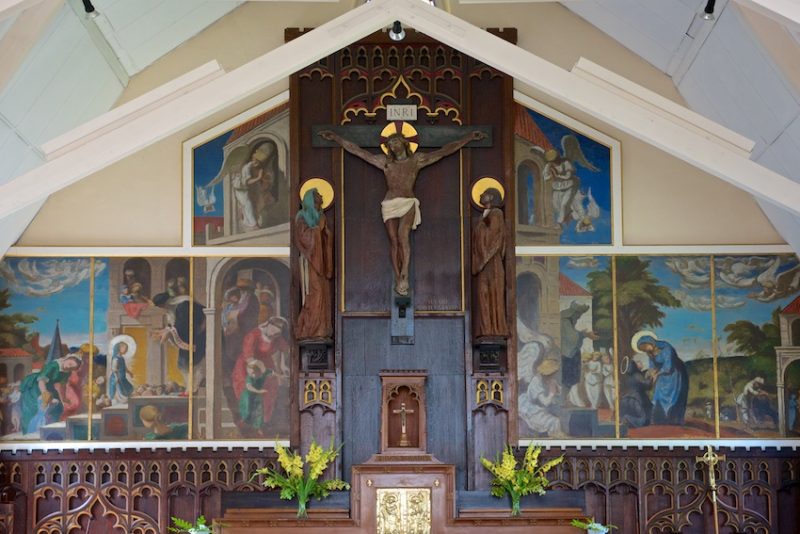
Murals by Edward Ardizzone

Entry to the Shrine of St Jude
Elias was a sociable man and, despite the early brush with scandal, opened a club in Newton Rd during the war for soldiers. His energy was prodigious. In 1953, he announced the building of a shrine to St Jude (see the story here) and bought Delbridge House by the station (sold recently for more than a million) which still had an acre of land at the back which is now the car sales showroom.
Delbridge House was to be a guest house for the parish. With his sharpness in money matters, Elias, hoping to raise money for its development, reported in the Carmelite News: ‘Any valuer whose opinion I have asked reckons that the house and grounds attached is worth £8500 as it stands. I bought it for £2250 as it stands. If you ask me the reason why I have been able to buy it at that price, all I can say is, that Faversham is a small town and it was a little too big for local users.’
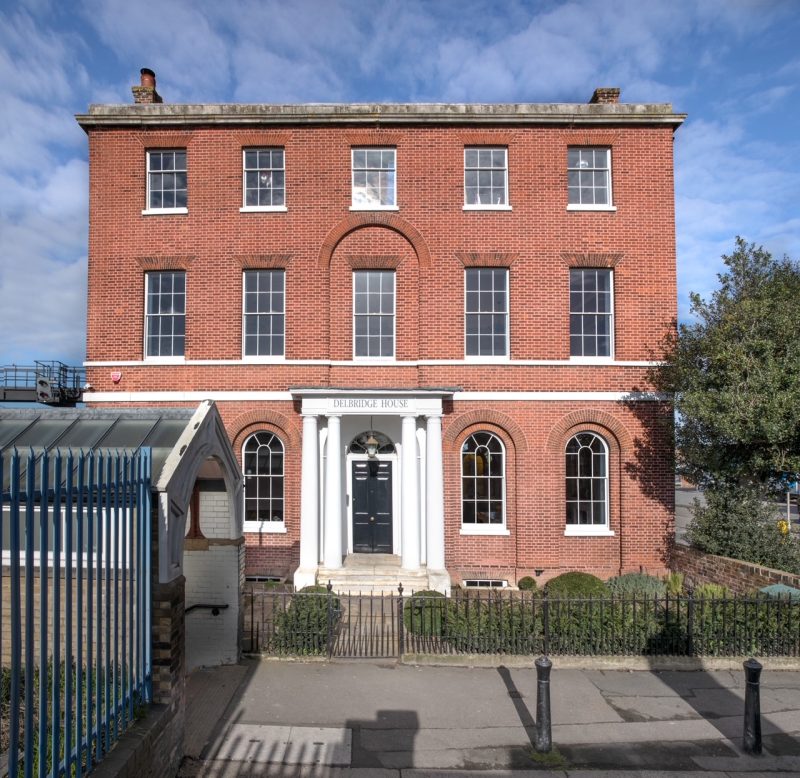
Delbridge House today
He was persuasive and by 1955, the Shrine was open and Delbridge House was up and running. Elias wrote in the Carmelite News: ‘It has, I think the smartest bar and dining room in North East Kent, and one thing that is not provided in normal places, a Ladies’ Powder Room that will bear comparison with any hotel on the South Coast.’ To his critics, he said: ‘I have done it because I believe that Catholics should set a headline and show other people how things ought to be done in social recreation.’
Interspersing the apparently relentless activity and progress, there was a reflective side to Elias. Born in the Wicklow Hills, he was a great lover of nature and learned to love the Kent countryside, writing: ‘So often I have driven through the Kentish lanes and byroads and have listened to the soft winds of the poplars that provide a windbreak to the hops.’
In the 1960s shortly before his death, Elias wrote: ‘Tanners St where I live, is like Harry Lauder’s stick, a compromise between a corkscrew and a hairpin bend. A dense ring of trees surrounds us and the birds twitter gaily when the weather is fine. If you are up very early in the morning you can see things that would startle you. A cock and hen pheasant picking on the law outside, squirrels searching for nuts in the hazel trees. No wonder we never see any. I planted them years ago so that we might have a few Kent cobs for Christmas, but the squirrels always get there first. They are the red squirrels not those grey tree rats we sometimes see… One morning I saw a hare sparring in the sunken garden. He was fighting nobody but himself.’ We don’t see red squirrels in Faversham now.
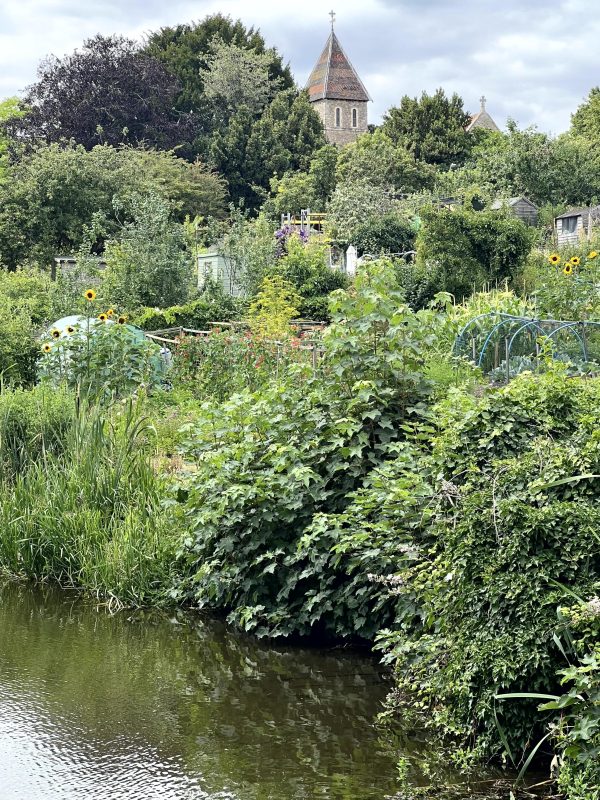
Stonebridge pond: The allotments and Davington Church spire in the distance
He also enjoyed watching the eels, then plentiful in Faversham and not critically endangered as today. ‘I loved to go down to a place called Stonebridge Pond, wander through the paths and little bridges over waterways to watch the eels come wriggling upstream.’ He describes stomping up Lower Rd with a stick wearing a sombrero: ‘There was a little bridge in the road and I used to look over the parapet to see if the eels had come up from the watercress beds. They used to lie in the shadow of the bridge away from the evening sun.’ It was on this walk that he encountered the ghost of a little girl with a skipping rope.
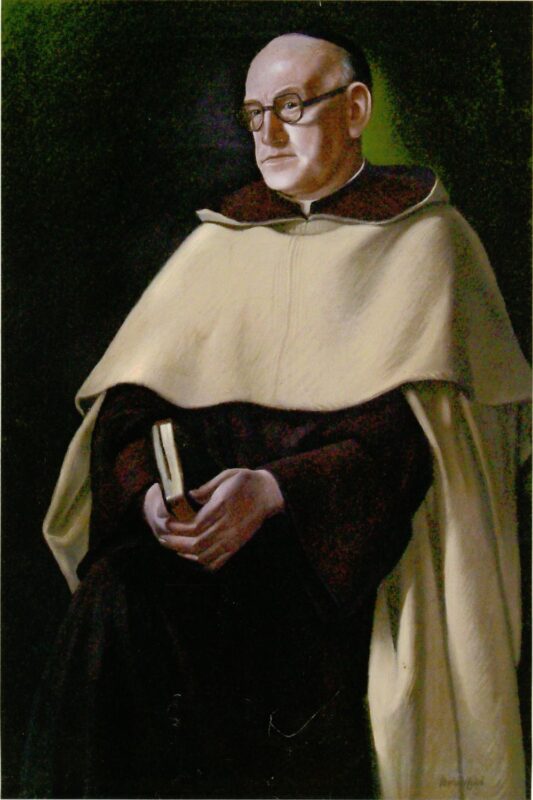
Portrait of Elias Lynch in Faversham by Michael Leigh
Whitefriars was Elias Lynch’s home until he died in the Cottage Hospital in 1967 just after his 70th birthday – by this time a major figure in Faversham and the British Province of the Carmelites.
Our Lady of Mount Carmel today houses the shrines of the Holy Child of Prague, the Little Flower St Therese of the Child Jesus and, most significantly, The Shrine of St Jude which draws pilgrims from all over the world.
From a small struggling parish, almost a missionary outpost, the British Province of the Carmelites grew. McGreal writes: ‘Much of the energy and money to buy back Aylesford Priory came from nearby Faversham and the Order’s apostolate today continues to depend on those who are loyal friends to the Carmelites through the work begun by Elias’.
There will be a centenary celebration at Whitefriars on 19 July and the publication of a new book about the Carmelites in the past 100 years.
Text: Posy Gentles. Photographs: Carmelite Charitable Trust and others
For more information and newsletters Whitefriars Faversham
Friar Beyond the Pale A biography of Carmelite Friar Fr Elias Lynch (1897 – 1967) by Wilfred McGreal O Carm. Saint Albert’s Press © British Province of Carmelites 2007